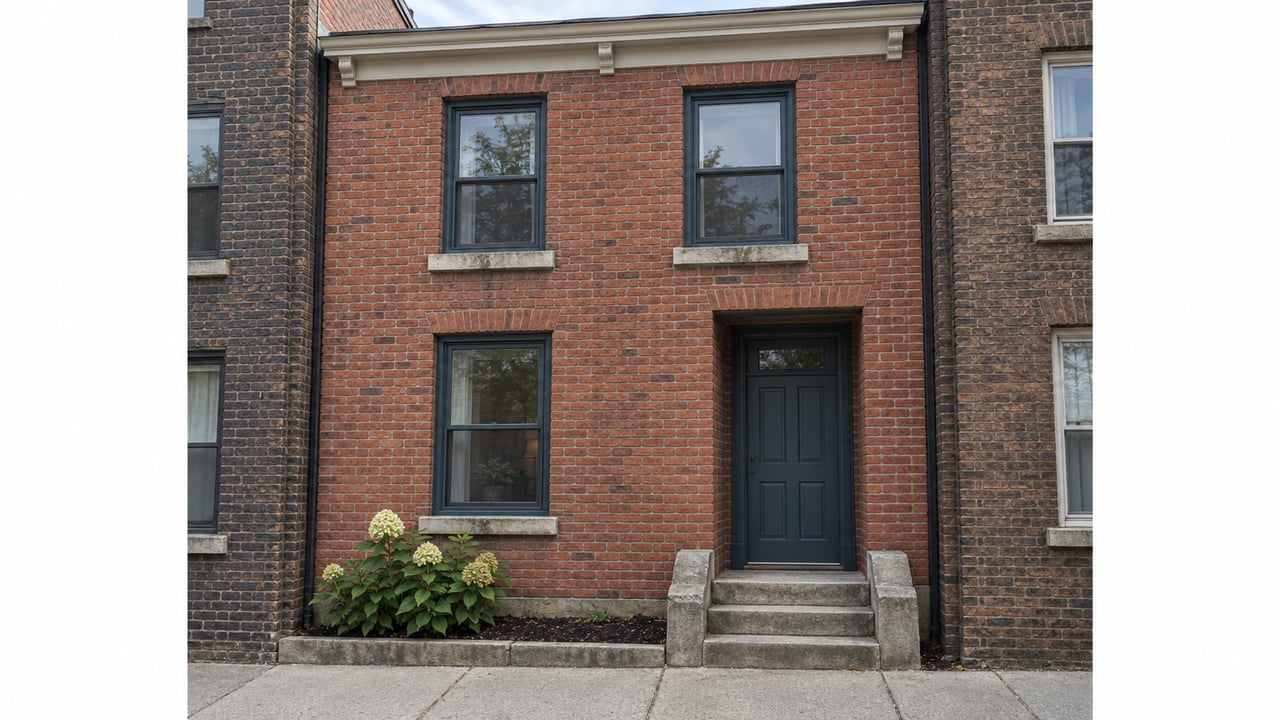
"It stays with the property, so whoever buys the property gets the savings." A seller in Upper Lawrenceville said this about his rebuilt 1900 row house on Harrison Street in an August 21, 2026 Pittsburgh Post-Gazette Buying Here feature. He explained that he pays City property tax only on the home's previous sale price because of an Act 42 abatement.
He is right that the savings transfer with the house. A buyer still needs one more fact before the savings mean anything, and that is how many years are left. On a renovated or newer home in Lawrenceville, the tax bill depends on when the building permit was issued and when the abatement started, and once the abatement ends it rises back toward full tax on the whole assessment. Because the City raised its millage by 20% for 2026, each remaining year is worth more than it was last year.
One house, two numbers
The Harrison Street home is one of 14 row houses on the street that a developer gutted. Buyers could add a third story. The current owner bought his in July 2020, and in August 2026 it was listed at $414,900. The Post-Gazette lists an Allegheny County assessment of $169,700 and annual taxes of $4,472. Over the prior three years, four homes on the 5200 block sold for between $305,000 in August 2024 and $537,000 in September 2025.
Compare that tax line with the 2026 rates. A City of Pittsburgh property in 2026 pays 6.430 mills to the County, 9.670 mills to the City and 10.457 mills to Pittsburgh Public Schools. That adds up to 26.557 mills, or $2,655.70 per $100,000 of assessed value. City properties also pay separate parks and library taxes, which WESA's 2026 calculator puts at 0.05% and 0.025%. Applying just the three main rates to the full $169,700 assessment gives roughly $4,507.
So the published tax figure is close to what the full three-body millage on the full assessment would produce, even though the owner describes paying City tax on a lower base. A listing summary can't settle that by itself. The figure might reflect the abatement, a homestead exclusion, a different tax year, or a calculation that leaves the abatement out. For anyone comparing monthly costs across several Lawrenceville homes, the tax line on a renovated house is the least reliable number on the sheet.
How the abatement transfers with the house
Pittsburgh's residential abatement is in Chapter 265 of the City Code. These are the rules that decide what a buyer actually inherits:
- It covers only the increase. The exemption applies to the part of the assessment that comes from the improvement or new construction. The land and the value the property had before the work stay fully taxable.
- It runs out all at once. For the standard program, 100% of the eligible assessment is exempt for three consecutive years, and then the exemption ends. The enhanced version runs ten years and also ends abruptly.
- The permit date sets the rules. The owner has to apply within 180 days of the first building permit. The exemption starts after the work is completed and assessed. The terms are those of the program in force on the day the permit was issued.
- The house keeps it after a sale. The code says the exemption is "upon the property exempted and shall not terminate upon the sale." A resale buyer gets whatever term remains, not a new one.
- It can be revoked. The City can deny or revoke an exemption while the property has a tax delinquency, a code violation, or unmet program conditions.
Points 3 and 4 together mean two similar renovated row houses a block apart can have very different tax futures. One may have years of abatement left. The other may lose it before the next bill. The listing price usually reflects finishes, square footage and the third-floor deck. Neither price shows where each house sits on its clock.
Lawrenceville's abatements were written under older, longer rules
The current program is shorter than the one much of Lawrenceville's new housing was built and marketed under.
In 2014, the Post-Gazette reported that the Pittsburgh Public Schools board voted 8-0 to bring back residential abatements that had expired in 2012. The citywide version ran three years. A ten-year "enhanced" version applied to targeted zones, and both Lower Lawrenceville and Upper Lawrenceville were on the list.
Four years later, NEXTpittsburgh described the new projects being marketed on that basis. Condos at The Wainwright, 3607 Butler St., were offered with an eight-year abatement on the first $250,000 of assessed value. The Lola Square and Carlton Court townhomes were described as qualifying for ten-year abatements.
In 2020, the City combined its programs into the current structure. On the City's real estate forms page, last updated September 1, 2026, the owner-occupied terms are:
| Program | Length | 2026 annual limit | What qualifies |
|---|---|---|---|
| Chapter 265 standard | 3 years | $247,786 assessed-value reduction | No added criteria |
| Chapter 265 Enhanced | 10 years | $250,000 assessed-value reduction | Located in a CDBG-eligible area, or a multi-unit for-sale project with at least 10% of units affordable at or below 80% of area median income |
The revised sections of Chapter 265 took effect June 30, 2020. The Harrison Street home was purchased in July 2020, so its sale came right around the date the program changed. Under the permit-date rule, the renovation permit decides which rules govern that abatement, not the closing date.
That leaves a wide spread across the neighborhood: 2018-era homes that may still have part of a long abatement left, homes permitted after 2020 under the three-year standard, and homes that never had an abatement. Whether a particular address falls in a CDBG-eligible area, which is what qualifies a post-2020 project for the ten-year term, depends on its exact location. The City's summary table doesn't map it block by block.
Why the 2026 millage increase makes each remaining year worth more
The abatement reduces assessed value. It isn't a fixed dollar credit, so the dollar savings rise and fall with the tax rate.
That rate went up. As PublicSource reported, City Council voted 6-2 on December 21, 2025 to raise the City millage from 8.06 to 9.67 for 2026. That works out to an additional $1.61 for every $1,000 of assessed value. The County had already gone from 4.73 to 6.43 mills for 2025, according to WESA. The school board set its 2026 rate at 10.457 mills.
Here is the effect on every $100,000 of abated assessment:
- At 2025's City rate of 8.06 mills: $806 a year in City tax not owed
- At 2026's City rate of 9.67 mills: $967 a year in City tax not owed
- City share of the 2026 combined 26.557 mills: about 36%
When the City abatement ends, the owner starts paying the City share at the higher 2026 rate. The other 64% of that three-rate subtotal, the County and school portions, needs separate confirmation for any given house. The Post-Gazette describes the Harrison Street abatement as applying to City taxes. The school district joined in 2014. We found no 2024 to 2026 record showing whether it matches the post-2020 City program, so school-tax relief on a given property is something to check, not assume.
Questions to answer about any abated listing
These are the facts that turn a listed tax figure into an actual carrying cost:
- Which taxing bodies does the abatement cover? City only, or City and school district?
- In what year did the exemption start, and in what year is it last in force? The code counts consecutive tax years, so the end date can be determined.
- When was the original building permit issued? That date decides whether the pre-2020 or post-2020 terms apply.
- What base does the exemption leave fully taxable? That is the land plus the assessment before the improvement. It is the floor the bill will settle near after the abatement ends.
- Is the property current on taxes and free of open code violations? Either one can lead to revocation.
Allegheny County's real estate portal shows the assessment for any parcel. The City's Real Estate Tax office handles abatement applications at [email protected].
Quick answers
Does a buyer have to reapply for the abatement? The code says the exemption stays with the property and doesn't end on a sale, so the remaining term carries over.
Can an older Lawrenceville row house get an abatement just by being bought? No. A purchase alone doesn't qualify. A qualifying improvement needs its own application, filed within 180 days of the building permit, along with the City's $60 application fee.
Does the County offer something similar for homes in the city? The County describes its LERTA as a program for commercial and industrial properties. Its homestead exclusion lowers assessed value for County taxes only.
When Allison Pochapin and our team compare renovated Lawrenceville homes for a buyer, we check each one's abatement start year, end year and permit date before putting monthly costs side by side. Schedule a consultation, and we'll go through those dates for the addresses on your list.
This article is general information, not legal, tax or financial advice. Consult a qualified professional about your situation.