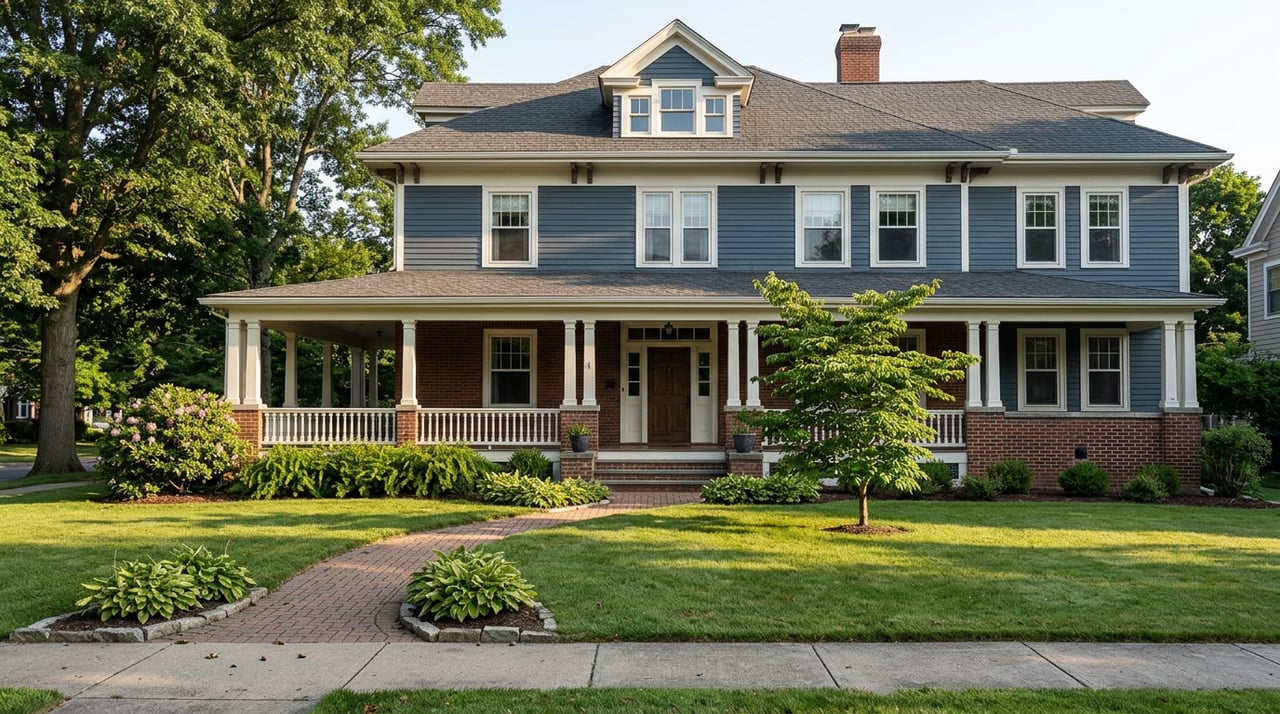
A buyer touring Highland Park this summer might have also toured a rowhouse in the Mexican War Streets the same week. Both listings used the same phrase: historic district. Both houses sit inside city limits, both show up on the National Register of Historic Places, and both come with the kind of period woodwork and leaded glass that justify the word historic in the first place.
What the listings don't say is that the two houses live under completely different rulebooks. One can be repainted, re-roofed, or have its porch rebuilt without a phone call to the city. The other requires a filing, a waiting period, and a hearing before a single shutter can change color. Buyers who assume "historic district" is one uniform category are pricing in a regulatory burden that, in Highland Park's case, mostly doesn't exist.
Two kinds of historic, one confusing word
The Highland Park Residential Historic District was listed on the National Register of Historic Places on August 30, 2007, and the designation covers almost the entire neighborhood, nearly 2,000 buildings in total. That listing exists to document and honor a neighborhood's architectural character. It does not create a permitting process. According to the neighborhood's own preservation advocates, the National Register listing carries few restrictions, and private homeowners remain free to renovate and build as they wish, ideally in keeping with the character of their street, but not because anyone is required to check.
Pittsburgh's true regulatory historic districts work differently, and they're not hard to find a few miles away. The city currently maintains roughly a dozen City Historic Districts, including Mexican War Streets, Manchester, and Schenley Farms, each created through a separate City Council designation rather than a National Register listing. Inside those districts, the city's Historic Review Commission has jurisdiction over any new construction, demolition, or exterior alteration visible from a public street or alley. Before an owner in the Mexican War Streets can replace a window sash or add a rear deck, the work has to be reviewed and approved by the commission, a process the neighborhood's own preservation society describes plainly on its site: exterior modifications need sign-off, and skipping that step risks a city building code violation.
The paperwork difference is concrete. HRC applications need to be submitted at least 13 business days before a hearing, and the commission's jurisdiction extends to anything visible from the street, not the interior and not anything tucked behind a fence line. None of that applies inside Highland Park. A buyer planning to update a kitchen, swap out vinyl replacement windows for something more period-appropriate, or add a dormer isn't filing anything with the city because of the historic designation. The National Register designation is announced right on the "Welcome to Highland Park" sign at the intersection of Stanton and Highland Avenue, but it is a statement of architectural significance, not a permitting requirement.
Why this matters if the house needs work
For a design-minded buyer weighing a fixer-upper, the practical difference shows up in timeline and cost. A renovation that would need a Certificate of Appropriateness in the Mexican War Streets or Manchester, plus the lead time for a hearing and the cost of producing drawings that satisfy the commission's design guidelines, moves at ordinary contractor speed in Highland Park. There's no review board deciding whether a new porch railing matches the block's historic character. The owner decides.
That flexibility cuts both ways. Nothing stops a neighbor from making a choice that clashes with the block's older housing stock, since there's no design review to prevent it. Buyers who are drawn to Highland Park specifically for its intact Victorian and early 20th century streetscape are relying on informal peer pressure and neighborhood norms to preserve that character, not city code. It's worth walking a target block at different times of day and looking at what recent renovations have actually done to nearby houses, since that's the only enforcement mechanism in play.
The other place the label misleads: the median price
Historic district status isn't the only place where one label is doing the work of several different facts. Pull Highland Park's median sale price from listing data this summer and the number changes depending on which slice of the market gets filtered in. Look at houses alone, and the trailing 12-month median sat around $480,000, down 17 percent year over year, with homes selling in roughly 68 days. Look at multi-family properties instead, and the trailing 12-month median for the same period was closer to $460,000, down 9 percent year over year, with days on market stretching to about 93. Condos posted a median around $507,500, also with a roughly 93-day average.
Three different medians, three different discount rates, three different timelines, all describing the same twelve-month stretch in the same neighborhood. That spread isn't a data error. It reflects a housing stock that genuinely doesn't behave as one market.
Highland Park's National Register nomination covers streetcar-era mansions on Highland and Stanton avenues alongside much smaller brick rowhouses and duplexes closer to Bryant Street. Baywood, the King family estate that once housed the Pittsburgh Art Museum and is documented as the birthplace of Richard King Mellon, sits on close to two acres along with six acres of scenic parkland and roughly 9,300 square feet of living space. A few blocks away, multi-family listings this year ranged from $450,000 to $715,000, and condo listings ranged from $375,000 to $839,000, prices that reflect a completely different scale of building.
A single quoted median for Highland Park is averaging a mansion market against a rowhouse market. Neither number is wrong. Neither number is useful on its own. A buyer comparing Highland Park to a more architecturally uniform neighborhood needs to ask which slice of Highland Park's stock they're actually shopping in before the median means anything.
What this looks like street by street
The pattern tracks fairly predictably by block. Highland, Stanton, and Negley avenues carry the largest, most architecturally elaborate houses, the ones built when the neighborhood was still a streetcar suburb for Pittsburgh's wealthier families escaping downtown congestion. Streets closer to Bryant Street, the neighborhood's small commercial spine, run toward more modest rowhouses and duplexes at a much smaller scale. Bryant Street itself remains the neighborhood's walkable core, anchored by spots like Joseph Tambellini Restaurant, Smiling Banana Leaf, Teppanyaki Kyoto, and the coffee shop Tazza D'Oro.
Knowing which side of that split a listing falls on tells a buyer more than the neighborhood median ever will.
A note for investor buyers
Because the entire neighborhood carries a National Register listing, an investor converting a Highland Park property to income-producing rental use may want to ask a CPA or preservation consultant whether a certified rehabilitation could qualify for federal historic rehabilitation tax incentives, which trace back to the Tax Reform Act of 1976 and apply to income-producing historic buildings that meet the Secretary of the Interior's rehabilitation standards. That's a narrower and more technical question than the renovation-freedom point above, and it applies to income property rather than owner-occupied homes, so it's worth a conversation with a tax professional rather than a general assumption either way.
Quick answers for Highland Park buyers
Does the historic district designation mean I need city approval to repaint my house or replace windows? No. Highland Park's designation is a National Register listing, not a City Historic District, so there is no Historic Review Commission oversight of exterior changes here.
Are any parts of Highland Park subject to the stricter city review process? Not currently. The city's locally-designated historic districts, the ones that trigger Historic Review Commission approval, are separate neighborhoods entirely, including Mexican War Streets, Manchester, and Schenley Farms.
Why do I see such different median prices for Highland Park depending on the source? Because the underlying housing stock spans multi-acre estates and modest rowhouses and duplexes, a single blended median averages two very different markets together. Filtering by property type gives a more honest comparison.
Highland Park rewards a buyer who looks past the label, whether that label is "historic district" or "median price." Knowing which block, which building type, and which set of rules actually apply is most of the work of making a smart offer here.
If you're comparing Highland Park to another East End neighborhood, or trying to figure out what a specific block's price history actually says about a house you're considering, the Allison Pochapin team can walk the comparison with you street by street. Schedule a consultation to talk through what a Highland Park purchase would actually look like for your situation.